





The most common question we get asked in our Glasgow clinic, before anything else, is some version of: “How many do I need?” It is a completely reasonable thing to want to know. But the honest answer is that it depends on things we can only assess in person, and anyone giving you a firm number without examining your scalp is guessing.
That said, there are patterns. Most cases fall into recognisable ranges, and knowing those ranges helps you go into a consultation with realistic expectations rather than starting from zero.
How Many Grafts Do I Need for a Hair Transplant in Glasgow?
A graft is not a single hair. It is a small unit of tissue containing anywhere from one to four follicles, extracted as an intact group. When a surgeon takes 2,500 grafts, the actual hair count is higher, usually somewhere between 1.8 and 2.5 times the graft number, depending on your individual follicle groupings. This matters when you are comparing quotes from different clinics, because some will quote in hairs rather than grafts, which can make a session sound bigger than it is.
The number of grafts needed for any given patient comes down to two things: how much area needs covering, and how much donor hair you have available to cover it. Both vary considerably between people, which is why the same degree of visible thinning can require 1,800 grafts for one person and 3,200 for another.
Graft Counts by Area
Hairline
A straightforward hairline recession, the temples pulling back and the front line rising, typically falls between 1,500 and 2,500 grafts. That is quite a wide range for what sounds like a specific, contained area. The reason is that hairlines are genuinely complicated to restore. A natural hairline is not a clean edge. It has corners at the temples, a softer central section, individual hairs at the very front that sit at very low angles, and microtransitional grafts right at the boundary. Getting that to look real takes more grafts than people expect.
Women’s hairlines need more than men’s for the same surface area. A feminine hairline is rounder and sits lower on the forehead, which means more coverage. We typically see female hairline transplant in Glasgow cases running from 2,000 to 2,800 grafts at the lower and middle range.
Crown
The crown is where graft requirements catch people off guard. It looks like a small, circular patch, but the math is against you. To break up light reflecting off the scalp, you need a minimum density across the whole zone, and the circular shape means grafts have to cover the area evenly rather than concentrating at a visible edge the way a hairline does. A moderate crown thinning is usually 1,500 to 2,500 grafts. More advanced loss, where the zone has expanded significantly, can be 2,500 to 3,500.
There is also an important conversation to have about crown progression. Hair loss in the crown area tends to keep going. Transplanting into an active crown without planning for future loss can leave transplanted hair as an isolated island surrounded by continuing recession. It is something we talk through carefully with every patient who comes to us with crown as the primary concern. See our page on crown hair transplant in Glasgow for a fuller explanation of how we approach this.
Hairline and Crown Together
Three to four thousand grafts, roughly, is what combining both areas requires for most patients. Sometimes more. Whether that is achievable in a single session comes down to your donor supply. When there is not enough to address everything at once, the hairline usually takes priority. It has more impact on how you look face-on, day to day, than the crown.
Extensive Loss
Patients with Norwood 5 to 7 loss, where recession covers most of the top of the scalp, are often looking at 4,000 to 6,500 grafts across one or two sessions. At this level the limiting factor is always donor supply, not technique. The safe donor zone on the back and sides of the scalp contains a finite number of follicles, and no procedure can take more than what is there.
We have patients come to us from Edinburgh, Aberdeen, and further north across Scotland specifically for an assessment at this stage of hair loss, because knowing what is realistically available from their donor area is as important as knowing what they want done. The two have to match.
Why Donor Supply Is the Actual Constraint
The follicles on the back and sides of the scalp are genetically resistant to DHT, the hormone responsible for pattern hair loss. When those follicles are moved to a new location, they keep that resistance. That is why transplanted hair does not fall out the way native hair does. It is also why the donor area is so carefully managed.
Most people have roughly 6,000 to 8,000 grafts available across their lifetime. Fine hair, limited safe donor zone coverage, or a history of previous procedures all reduce that figure. Some patients have more. A minority have significantly less. Without a physical assessment, there is no way to know which category you fall into, and this is the number that ultimately determines what is possible.
People sometimes ask whether body hair can supplement the scalp donor area. It can, in specific circumstances, but it is not a routine option. Body hair characteristics differ from scalp hair and results are generally less consistent. It is a fallback for cases where scalp donor supply is genuinely insufficient, not a standard addition.
Graft Count and What It Costs
Pricing for hair transplants in Glasgow is based on session size, measured in grafts. Larger sessions tend to have a lower per-graft rate than smaller ones, though the total investment rises with the number of grafts required.
For a full breakdown of current pricing by session size, see our hair transplant cost in Glasgow page. As a rough frame of reference, most patients fall into one of the following ranges:
- Hairline only: 1,500 to 2,500 grafts
- Crown only: 1,500 to 3,500 grafts
- Hairline and crown: 3,000 to 4,500 grafts
- Extensive restoration: 4,000 grafts upwards
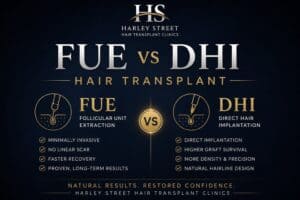
The technique matters too. FUE hair transplant in Glasgow is the most commonly used method and suits the majority of patients. FUT, which takes a strip from the donor area rather than extracting follicles individually, can yield a higher graft count from a single session and is worth discussing if your requirements are at the upper end of the range or if you would prefer not to shave the donor area.
If you’re weighing up those two approaches, our FUE vs FUT breakdown covers the practical differences — scar profiles, recovery, and which patient types suit each technique.
Make the best investment in yourself and find out more about how we can help eliminate hair loss for good!
Frequently Asked Questions
Not really. Online calculators and photo-based estimates can give you a rough idea of range, but they cannot account for donor density, hair calibre, or how the loss has progressed over time. An in-person assessment takes around 45 minutes and gives you a specific number based on your actual scalp, not an average.
It is more common than people expect, particularly in patients with advanced loss. In those cases we prioritise by impact: the hairline first, then the mid-scalp, then the crown. Staging across two sessions is also an option where supply allows a second procedure after a period of rest for the donor area.
No. The number of grafts the recipient area can support is limited by its blood supply. Placing more grafts than the area can sustain reduces survival rates for individual follicles. Getting the density right matters more than placing the maximum possible number. An experienced surgeon will work within what the area can support.
Yes, in most cases. A second session can increase density in previously treated areas once the first procedure has fully grown in, which typically takes 12 to 18 months. Many patients plan for this from the outset, particularly those addressing both the hairline and crown in stages.
A session of around 2,000 grafts takes roughly 6 to 8 hours. Larger sessions of 3,000 to 4,000 grafts run 8 to 10 hours. You are awake throughout, under local anaesthetic, and can watch something or listen to music during the procedure. Most patients say it is more comfortable than they expected.
Most surgeons keep sessions within 4,000 to 5,000 grafts to protect graft viability and manage the length of the procedure safely. Above that level, the risks associated with graft survival outside the body increase, and session fatigue becomes a factor for both the surgical team and the patient. Cases requiring more are typically split across two sessions.
Patient Testimonials
Aside from achieving fantastic results, we believe that keeping in touch with our patients before, during and after their hair transplantation procedure is paramount – it helps to keep our patients feeling calm and in control. We’re always on hand to provide guidance, support and aftercare advice. Time and again, our patients tell us that this is what sets us apart from other clinics.
You can read our great reviews of FUE hair transplants over on Google and Trustpilot