




Most people asking about FUE vs FUT have already made up their mind. They’ve read something online, decided FUE sounds better, and want someone to confirm it. Sometimes that instinct is right. Sometimes it isn’t, and the reason comes down to something specific about their situation that generic comparisons don’t account for.
Both techniques work. Both produce permanent results. The question isn’t which one is superior — it’s which one suits you.
FUE vs FUT Hair Transplant in Glasgow: What’s Actually Different
The difference is in how grafts are removed from the donor area, not in what happens after.
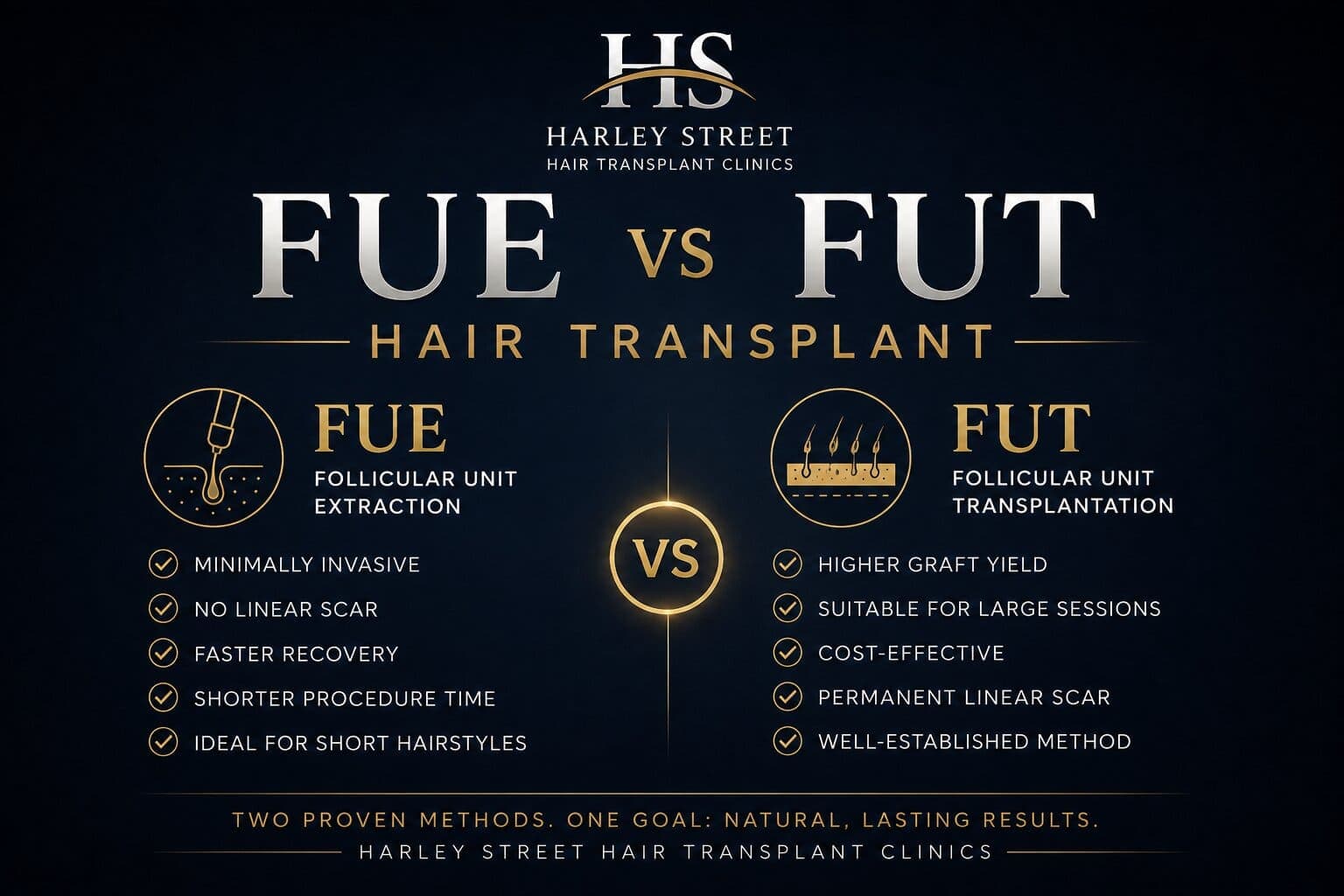
In FUE hair transplant, each follicular unit is extracted individually using a small circular punch tool, typically 0.75 to 0.8mm in diameter. There’s no incision, no sutures, and no linear scar. The extraction points heal as tiny dots scattered across the donor area — visible only if you shave your head very short.
In FUT hair transplant, a strip of scalp is removed from the donor area and dissected under a microscope to separate individual follicular units. The site is closed with sutures and heals as a single horizontal scar, which sits below the natural hairline and is covered by surrounding hair at most lengths.
Once the grafts reach the recipient area, the implantation process is identical. The results, when done well, are indistinguishable.
The Donor Area Scar
This is what most people are actually asking about when they compare the two techniques. And it’s worth being clear about what the difference really means in practice.
FUE produces no linear scar. The extraction points are small enough that they heal without visible scarring at most hair lengths. If you wear your hair cropped short on the back and sides, or if you regularly shave your head, FUE is the obvious choice — the donor area will be essentially undetectable.
FUT produces a linear scar. It runs horizontally across the back of the scalp, typically in the lower donor zone. With hair at a normal length — say, a grade 3 or above on the sides — it’s not visible. But if you ever wanted to cut your hair very short at the back, it would show.
For some patients, that distinction matters enormously. For others, who have no intention of ever shaving their head, it’s almost irrelevant.
Why Some Patients Are Better Suited to FUT
FUE is the technique used for the vast majority of hair transplant patients. But there are specific situations where FUT is the stronger option, and it’s worth knowing what they are rather than dismissing it as the “old” method.
Patients who don’t want to shave the donor area. FUE requires shaving the back of the scalp before extraction. FUT doesn’t — the strip is taken from beneath the existing hair and the surrounding hair covers the site almost immediately after the procedure. This makes FUT the preferred technique for women undergoing hair transplants, for transgender patients who want to maintain hair coverage throughout the process, and for any patient where shaving is not acceptable for personal or professional reasons.
Patients needing a very high graft count. FUT can yield a larger number of grafts from a single session than FUE in some cases, because the strip gives the surgeon access to a defined zone of optimal donor hair in one step. With FUE, there is more flexibility in where individual grafts are selected from, but the per-session ceiling can be lower depending on donor density.
Patients with difficult donor anatomy. When follicle angles are unusually steep or the donor scalp is tight, individual extraction becomes technically harder and transection rates (damaged follicles) can rise. A strip excision sidesteps this problem entirely, with the follicles dissected cleanly from the tissue under magnification.
Why Most Patients Choose FUE
No linear scar is the main reason. But there are others.
Recovery is faster. There are no sutures to remove, no wound management for a strip site, and most patients are back to desk work within a few days. The donor area feels less sore in the days after the procedure. Our guide to hair transplant recovery covers what the first two weeks look like for both FUE and FUT patients.
FUE also allows the surgeon to cherry-pick grafts from across the entire safe donor zone — not just from a single strip location. In patients with uneven donor density, this matters. The surgeon can draw from whichever parts of the donor area have the best follicle groupings and calibre for the recipient site being treated.
And for patients who might want a second procedure in future, FUE preserves more options. The donor area can be accessed again across different extraction zones, whereas a second FUT procedure requires a new strip from a site that has already been through surgery once. Understanding your overall donor supply — and how much is realistically available for future sessions — is something our guide to graft planning goes into.
The Transection Rate Question
Transection means a follicle is damaged or severed during extraction and cannot be transplanted. It’s a factor with FUE specifically, because the punch tool has to follow the angle of each follicle beneath the skin, and angles vary.
In experienced hands the transection rate with FUE is low — typically under 5%. In less experienced hands, or with certain hair types (very curly or afro hair, where follicles curve beneath the skin in a J or C shape), it can be higher. A larger punch tool, 0.85 to 0.9mm, is used for these cases to reduce the risk.
FUT has a lower transection risk because the dissection happens under microscope with direct visibility of each follicle. But a higher transection rate with FUE in experienced hands does not translate to a worse result — the total graft count is planned to account for this.
Which One Is Right for You
There is no universal answer. What we find in our Glasgow clinic is that the conversation usually narrows down quickly once a patient has thought through two questions: how short do you ever wear your hair at the back, and do you mind shaving the donor area for the procedure?
If your hair is always worn at a reasonable length and you’re comfortable shaving the back for a day, FUE suits most patients well. If you wear your hair cropped short and the idea of a linear scar bothers you, FUE is the right call. If you’d prefer not to shave at all — or if you’re a woman or trans patient for whom maintaining hair coverage matters — FUT is worth a serious conversation.
We see patients from across Scotland for consultations in Glasgow, and the technique question comes up in almost every one. It’s not a decision that needs to be made before you come in. A surgeon can assess your donor area, your hair characteristics, and what you want to achieve, and give you a clear recommendation based on your specific situation rather than a general preference.
Make the best investment in yourself and find out more about how we can help eliminate hair loss for good!
Frequently Asked Questions
Neither is categorically better. When performed by an experienced surgeon, FUE and FUT produce results of equivalent quality. The difference is in the donor area experience and the scar left behind — not in how the transplanted hair grows or looks.
Yes, in most cases. Some patients have FUE as a first procedure and FUT as a second to access a different part of the donor zone, or vice versa. It depends on the current state of the donor area and how much has already been extracted. A surgeon can assess this at consultation.
Both procedures are performed under local anaesthetic, so neither should be painful during the extraction. FUT tends to produce more post-operative soreness in the donor area in the first few days because of the strip wound. Most patients manage this with standard over-the-counter painkillers and it settles within a week.
The sutures are usually removed 10 to 14 days after the procedure. The scar itself continues to mature over several months, typically fading and flattening considerably by 6 to 12 months post-op. Final scar appearance varies by individual skin type and healing response.
Yes — FUT is often the preferred technique for female patients specifically because it does not require shaving the donor area. The strip site sits beneath the surrounding hair and is not visible at normal lengths. Women undergoing hairline restoration or density work are frequently better suited to FUT than FUE for this reason.
Very curly hair presents a specific challenge for FUE because the follicles curve beneath the scalp surface, making individual extraction harder without damaging the follicle. A larger punch tool is used in these cases, and a surgeon with experience in afro hair extraction is important. FUT can also be considered, as the dissection process under magnification is less affected by follicle curve angle.
Patient Testimonials
Aside from achieving fantastic results, we believe that keeping in touch with our patients before, during and after their hair transplantation procedure is paramount – it helps to keep our patients feeling calm and in control. We’re always on hand to provide guidance, support and aftercare advice. Time and again, our patients tell us that this is what sets us apart from other clinics.
You can read our great reviews of FUE hair transplants over on Google and Trustpilot