
Short for: Follicular Unit Excision
Surgery: Doctor-led
Time Taken: 6-9 hours
Price: £3,000 – £7,000
Finance available





Short for: Follicular Unit Excision
Surgery: Doctor-led
Time Taken: 6-9 hours
Price: £3,000 – £7,000
Finance available
Every procedure at our Glasgow clinic is performed by a doctor on the GMC register
Our clinic is in the heart of Glasgow, a short walk from Buchanan Street subway and Queen Street station
Your surgeon is fully dedicated to your procedure from start to finish
Honest assessment of your donor hair and realistic outcome, no hard sell
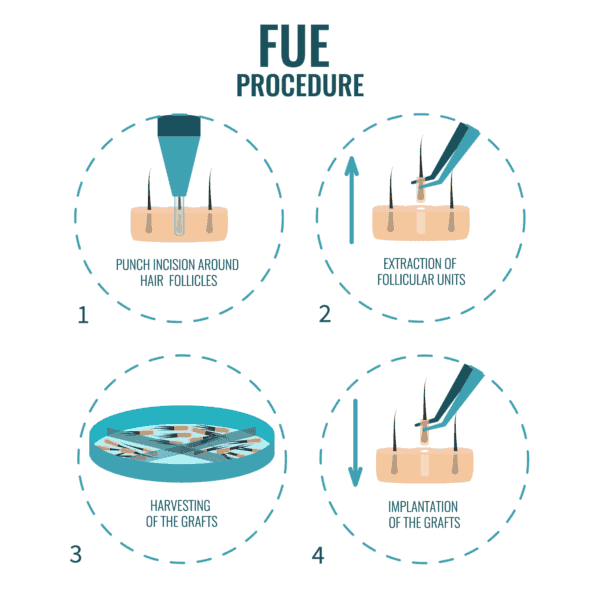
FUE, or Follicular Unit Extraction, is the most widely performed hair transplant technique in the world and the most common procedure we carry out at our clinic on Buchanan Street. It works by extracting individual hair follicles from the donor area at the back and sides of the scalp and implanting them precisely into areas of thinning or loss. No strip of skin is removed, no stitches are required, and the donor area heals leaving only small circular marks that are not visible under normal hair length.
Most patients choose FUE because it delivers a natural result without a visible linear scar, suits a wide range of hair loss patterns, and scales well across graft counts, from targeted hairline procedures to larger sessions covering the crown or mid-scalp.
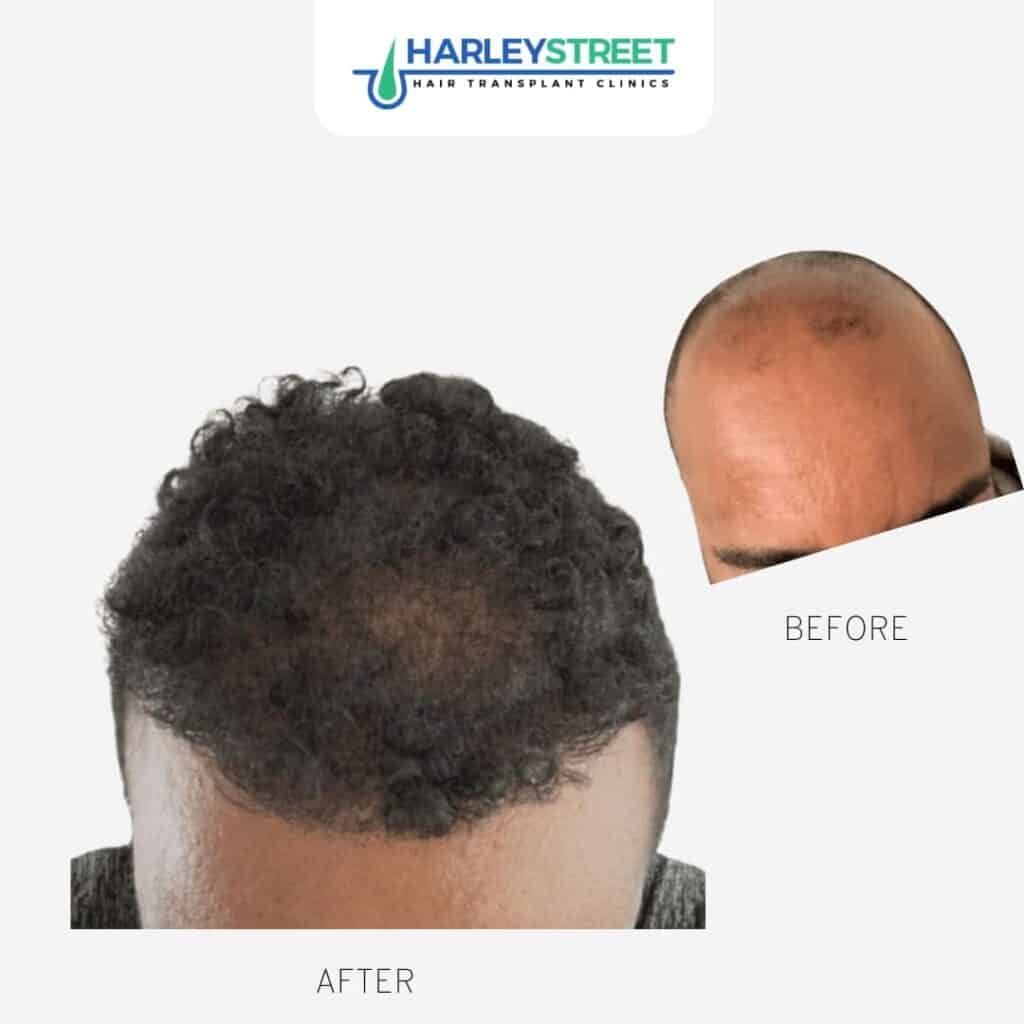
A selection of results from patients treated at our Glasgow clinic. All procedures were performed by our GMC-registered surgeons.
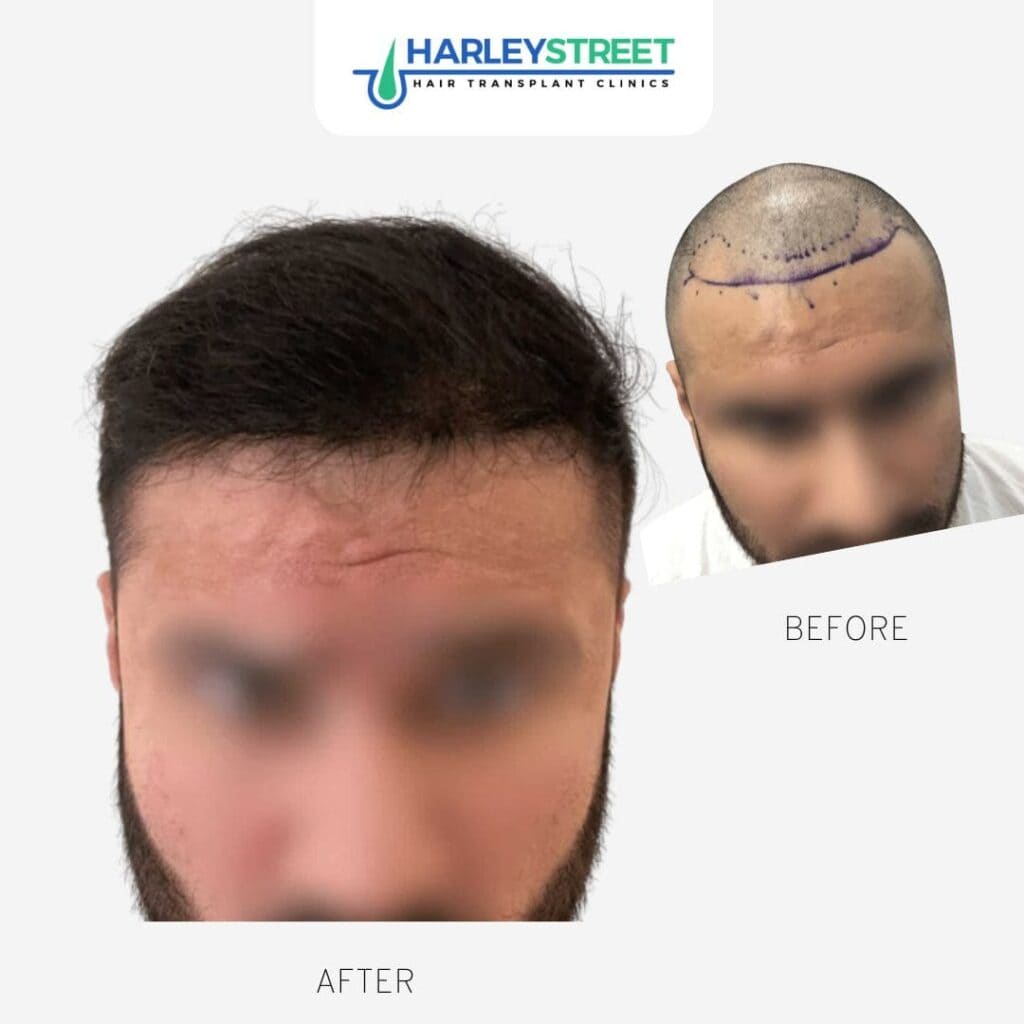
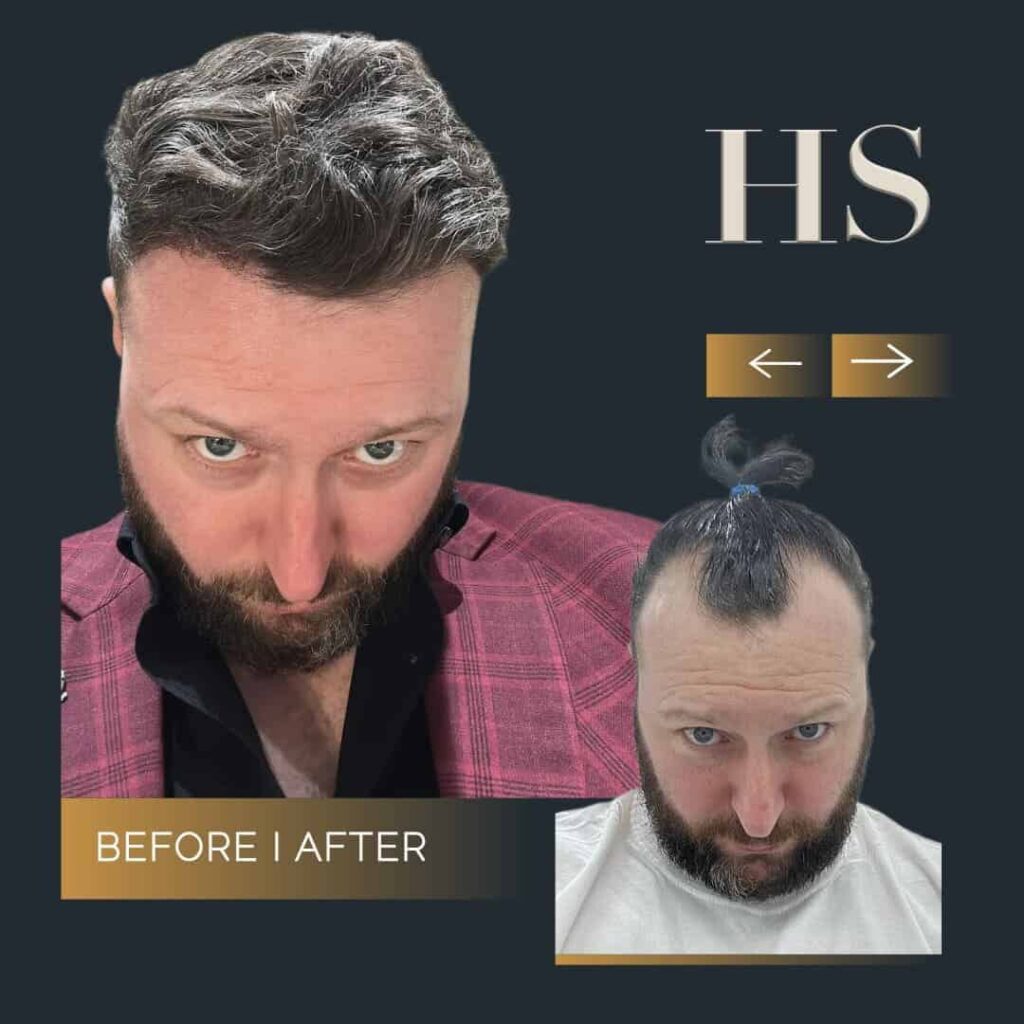
The day itself runs from around six to nine hours depending on the number of grafts, and you are seated and comfortable throughout. Local anaesthetic handles the pain; most patients watch films, listen to music, or sleep during the longer sessions. There is no general anaesthetic and no overnight stay.
Extraction is the first stage and the one that takes up most of the day. A small punch tool is placed around each follicular unit in the donor area and the follicle is extracted from the surrounding tissue. The standard punch is 0.75 mm to 0.8 mm. In patients with very curly or afro hair, the follicles curve beneath the skin in a J or C shape rather than growing straight, so a slightly larger punch of 0.85 mm to 0.9 mm is used to follow that curve and reduce the risk of transection. The same wider margin applies in other cases where the donor anatomy requires additional care. One of the real advantages of FUE over the strip method is that the surgeon selects grafts individually, prioritising the strongest follicles from across the donor zone rather than being limited to whatever sits in a given strip.
While extraction is underway, the extracted follicles are held in saline solution. Once they are ready, the surgeon prepares the recipient area: small channels are made at precise angles matching the natural direction of the surrounding hair. Single-follicle units go at the front edge, denser two and three-hair units behind them. The angle, depth, and spacing of each channel determine how natural the result looks once the hair grows.
The donor area heals without sutures. The small circular marks left by the punch close over within a week or two and are not visible once the donor hair returns to a normal length.
FUE is the most commonly performed technique at our Glasgow clinic and suits the large majority of patients. For some cases, an alternative approach may be more appropriate. DHI uses a Choi Implanter Pen to implant follicles without pre-made channels, which offers additional precision and allows the recipient area to remain unshaved. FUT is a strip-based technique that is occasionally better suited to patients who do not want to shave the donor area. Your surgeon will discuss which technique is right for your case at your free consultation.
Male pattern baldness is the most common reason men come to the clinic, and FUE handles it well across the full range of Norwood grades, from early hairline recession to significant crown loss. The same approach works at the hairline, temples, mid-scalp, and crown, with graft selection and placement adapted for each zone. The absence of a linear scar is relevant for anyone who wears their hair short or wants that option later: FUE leaves only small circular marks in the donor area, invisible at any normal length.
The technique extends naturally to beard transplants and eyebrow transplants, where individual follicles from the scalp donor area are placed in the face or brow region with close attention to the angle and natural growth direction. It is also commonly used in transgender hair transplants, where the precision of individual graft selection and placement suits the detailed reshaping those procedures involve. If you are unsure whether FUE or an alternative technique is right for your situation, that conversation happens at the free consultation based on your specific donor density, graft count, and what you want to achieve.
The first evening is fine for most people. The recipient area is reddened and a little tender, which is expected. You leave with a saline spray and the instruction to apply it to the transplant area every 30 minutes while you are awake for the first few days. Antibiotics start on the day of surgery; painkillers are available as needed. The day after surgery, you remove the bandage from the donor area and apply the antiseptic cream provided.
Sleeping takes some adjustment for the first week. A travel pillow at roughly 45 degrees keeps the transplant elevated and limits the swelling that would otherwise pool around the forehead and eyes. It becomes normal quickly. If a headband was provided, that comes off on day five.
Washing starts on day three. You pour water gently over the area rather than applying direct shower pressure. No rubbing. From day seven you can begin to touch the transplant site when washing. By two weeks post-surgery, normal water pressure is fine.
The shedding phase runs from around week two through to week eight and is the part that catches most patients off guard. The transplanted hairs fall out. This is correct. The follicles are alive beneath the skin, entering a resting phase before producing new growth. The result has not failed; it has just not started yet.
New hairs begin emerging around months three to four, initially fine and sometimes lighter in colour before they thicken. Most patients see a meaningful change by month six. The full result, including the denser, more mature growth that develops later, takes 9 to 18 months depending on the area treated. The crown tends to be the last to fill in completely.
The cost of an FUE hair transplant at our Glasgow clinic is determined by the number of grafts required, which depends on the extent of your hair loss and what you want to achieve. Smaller procedures targeting a receding hairline or adding density to the temples require fewer grafts than full crown or scalp restoration.
A typical FUE procedure at our clinic involves between 1,500 and 3,000 grafts, though some cases fall outside this range. The exact number is confirmed at your free consultation based on your donor density and the coverage you are aiming for. Your patient advisor will provide a full personalised quote at that stage.
For a full pricing breakdown, our hair transplant cost page covers every graft band with the fees applied at our Glasgow clinic. Finance options are available if you prefer to spread the cost.
Make the best investment in yourself and find out more about how we can help eliminate hair loss for good!
Hair Transplant Glasgow is centrally located and easily accessible from across Scotland. Find us in Glasgow City Centre:
Hair Transplant Glasgow
69 Buchanan Street
Glasgow
G1 3HL
Our Glasgow clinic is well connected by public transport:
If you are travelling by car, the clinic is a short drive from the M8 motorway with several car parks nearby, including the Buchanan Galleries multi-storey.
FUE, or Follicular Unit Extraction, is a hair transplant technique where individual hair follicles are extracted one by one from the donor area using a small punch tool, then implanted into areas of thinning or loss. No strip of skin is removed and no sutures are required. It is the most commonly performed hair transplant technique at our Glasgow clinic.
Neither is universally better. It depends on your situation. FUE is generally preferred for larger sessions, is more affordable, and is the standard choice for most hair loss patterns. DHI offers greater precision per graft and does not require the recipient area to be shaved, which suits patients wanting density work between existing hair or those who strongly prefer to avoid shaving. Your surgeon will recommend the right technique at your consultation.
A typical FUE procedure takes between six and nine hours depending on the number of grafts. It is performed in a single day at our Glasgow clinic under local anaesthetic.
FUE does not leave a linear scar. The small circular extraction points in the donor area close over within one to two weeks and are not visible once the donor hair grows back to a normal length. This is one of the main reasons patients choose FUE over FUT, particularly those who want the option of wearing their hair short.
New growth typically begins to emerge between months three and four, following an initial shedding phase. Meaningful coverage is usually visible by month six. Most patients reach around 60% of their final result by month nine, with the remainder developing up to month 12 or 18 in some areas such as the crown.
The cost depends on the number of grafts required and the complexity of your case. Your patient advisor will provide a full personalised quote following your free consultation. Visit our hair transplant cost page for a pricing guide. Finance options are also available.
Aside from achieving fantastic results, we believe that keeping in touch with our patients before, during and after their hair transplantation procedure is paramount – it helps to keep our patients feeling calm and in control. We’re always on hand to provide guidance, support and aftercare advice. Time and again, our patients tell us that this is what sets us apart from other clinics.
You can read our great reviews of FUE hair transplants over on Google and Trustpilot