





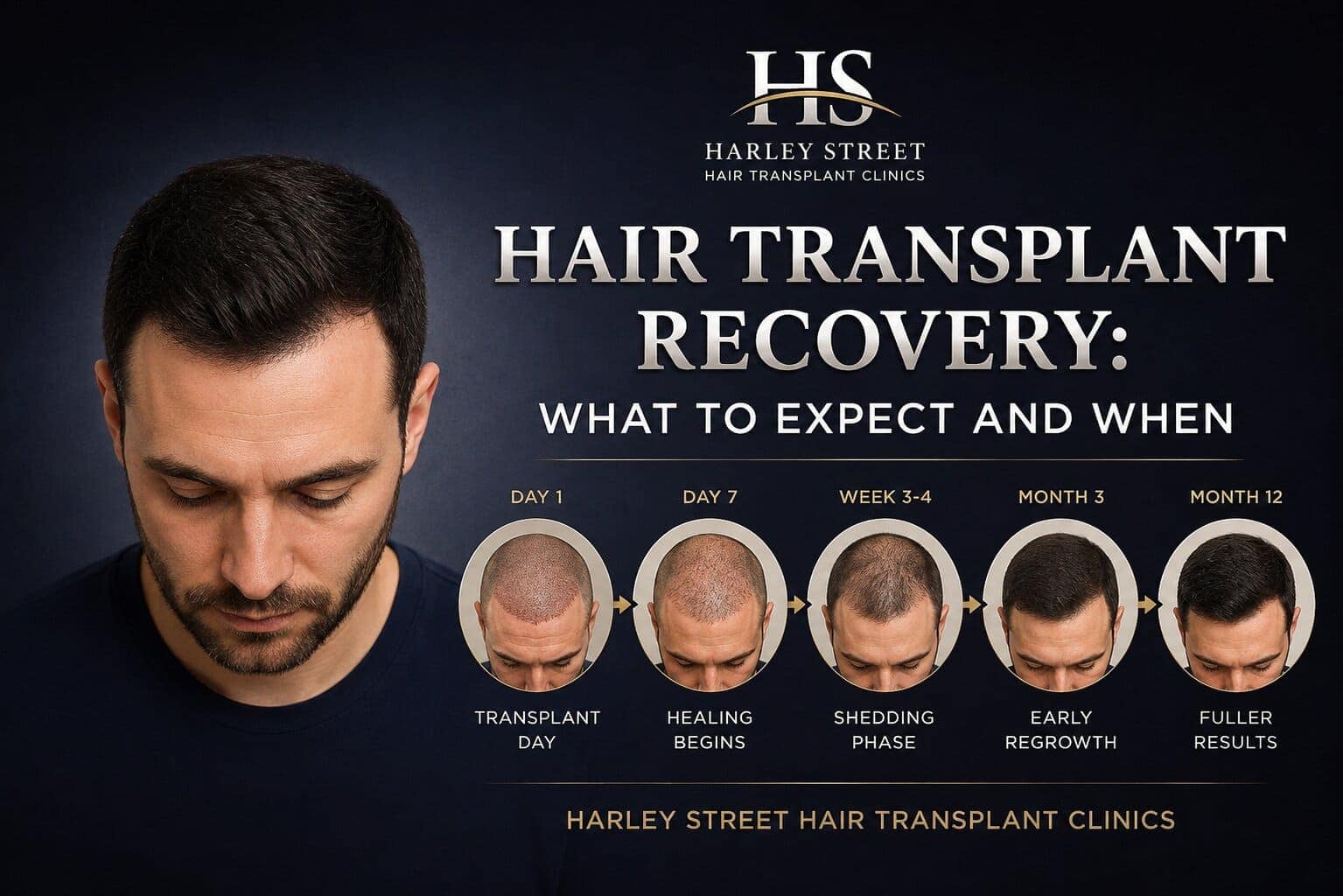
Hair Transplant Recovery
Hair Transplant Recovery: What to Expect and When
Most people book a hair transplant having researched the procedure itself thoroughly. They know the technique, they’ve seen the before and afters, they understand roughly how many grafts they need. What they’re usually less prepared for is the recovery, specifically the parts that look like failure but aren’t. This guide covers the full recovery timeline, but more usefully, it explains what’s actually happening at each stage and why so many patients misread the signals.
Hair Transplant Recovery in Glasgow: The First Ten Days
The first ten days are the most medically significant part of recovery, even though nothing dramatic happens. Transplanted follicles haven’t yet “bedded in” and established a blood supply in their new position. They’re surviving on a process called plasmatic imbibition, essentially absorbing nutrients directly from the surrounding tissue fluid. This is why the first week is so focused on protection rather than growth.
On the day of surgery, you’ll leave our Buchanan Street clinic with the recipient area still tender and the scalp reddened. Swelling typically builds over days two and three before clearing. It tends to descend into the forehead and around the eyes, which looks worse than it is. Sleeping at roughly 45 degrees for the first seven nights reduces this significantly. We include a travel pillow in the aftercare pack precisely because patients forget this detail and then wonder why they’re more swollen than expected.
In the hours after surgery, you spray the recipient area with the saline solution provided every 30 minutes while awake. This continues for the first three days and keeps the grafts moist during a critical window. The following morning, you remove the bandage from the donor area at home and apply the antiseptic cream provided. Start any antibiotics on the day of surgery itself, and take painkillers as needed in the first couple of days.
The first wash of the transplant area starts on day three. For the first few days of washing, technique is everything: pour water gently over the area without rubbing, without touching, without direct shower pressure on the recipient site. From day seven onwards, you can begin to gently touch the area when washing. Two weeks out, normal water pressure to the transplant area is appropriate. If you were given a headband, keep it on for the first five days. Scabs form across the recipient area between days five and seven. The instruction is simple: don’t touch them. A scab pulled off before it separates naturally can take the follicle with it, and that graft is gone permanently.
One practical note for patients travelling from elsewhere in Scotland: the drive back from Glasgow after surgery shouldn’t be done alone. The local anaesthetic means you won’t be in pain, but the combination of medication and the concentration required for a long drive isn’t sensible. If you’ve come from Edinburgh, the Highlands, or further, arrange a driver for the return journey and plan to rest properly when you get home rather than heading back into normal life that evening.
Most patients with office-based jobs return to work within five to seven days. Physical work, outdoor roles with significant sun exposure, or anything involving manual labour needs a longer window, usually two weeks minimum, sometimes more depending on the nature of the job.
The Shedding Phase: Understanding What’s Actually Happening
Between roughly weeks two and eight, the transplanted hairs shed. This is the part of recovery that causes the most anxiety, and often the most unnecessary phone calls to clinics, because it looks exactly like the transplant has failed. The scalp can look worse at week four than it did before surgery. For patients who weren’t clearly warned this would happen, it can feel like a catastrophe.
It isn’t. But the explanation matters, because there’s a distinction that most recovery guides don’t make clearly enough: the difference between shedding and graft failure.
Shedding is what happens to successfully transplanted follicles. The physical stress of extraction and re-implantation causes the follicle to enter a resting phase. The hair shaft falls away, but the follicle itself remains alive and anchored beneath the skin. It will produce new hair from around month three onwards. This is a normal biological response to surgical trauma.
Graft failure is different. It means the follicle itself didn’t survive. This is far less common when surgery is performed correctly and aftercare instructions are followed. Signs that suggest a graft may not have survived include persistent redness or infection at specific sites, or the absence of any new growth in an area after month five or six (when surrounding areas are showing progress).
The reason this distinction matters: patients who don’t understand it either panic unnecessarily during shedding, or, worse still, fail to recognise the signs of a genuine issue when one does occur. Most of the time, what feels like failure at week four is entirely normal. But knowing what you’re actually looking for means you can make that judgement accurately rather than guessing.
Something else worth mentioning here: some patients experience what’s called shock loss, where existing hair near the transplanted area also sheds temporarily. This is caused by the general surgical trauma affecting nearby follicles, not by the transplant technique itself. It almost always grows back. It’s different from the shedding of transplanted hair, and it’s different from graft failure. Three separate things, but patients often conflate all of them.
Months Two to Four: The Phase Nobody Talks About Honestly
After the shedding phase, there’s a period of apparent stillness that runs roughly from month two to month four. The scalp looks quiet. The shedding has stopped, but new growth hasn’t begun in any visible way. This is the stage that generates the most clinic contacts of the entire recovery period, and the honest answer we give every time is: this is normal, and there’s nothing productive you can do to speed it up.
What is actually happening beneath the surface during these months is significant, even if it’s invisible. The follicles are re-establishing their blood supply and anchoring into the surrounding tissue. The cellular infrastructure for hair production is being rebuilt. None of this is visible from outside the scalp, which is why this phase feels so unremarkable, but it’s doing the foundational work that determines the quality of the eventual result.
The only things worth doing during this phase are continuing any medication your surgeon recommended (finasteride or minoxidil, if applicable), attending follow-up appointments, and photographing the scalp monthly in consistent lighting. That last point is more useful than it sounds. The growth phase is gradual enough that it’s hard to perceive day-to-day, but comparing a photo from month two to one from month six makes the progress obvious. Patients who don’t photograph their progress often underestimate how far they’ve come.
Resist the urge to try things that aren’t part of the agreed aftercare plan. We see patients who’ve started new supplements, changed their diet dramatically, or started using products they read about online during these months. Some of these are harmless. Some aren’t. Check with the clinic before adding anything.
When Does Hair Actually Grow Back?
New hairs typically begin to emerge between months three and four, often fine and sometimes colourless at first, easy to miss without close inspection in good lighting. By months six to nine, growth becomes meaningful and density starts to build. The hair thickens and pigments as the follicles mature through their first full growth cycle post-transplant.
A useful benchmark: most patients reach around 60% of their final result by month nine. The remainder develops up to month 12, and in some areas, particularly the crown, up to month 18. This is why we don’t consider a result finalised until 18 months post-surgery, regardless of how good it looks at 12.
Growth during this phase is rarely even. Different areas, and even individual follicles, will be at different points in their cycle at the same time. Patches that look sparse at month six will fill in. This unevenness isn’t a sign that something went wrong in those specific areas, it’s just the natural asynchrony of hundreds of follicles restarting at slightly different points.
One advantage for Glasgow patients that doesn’t get mentioned often: Scotland’s climate is genuinely helpful during recovery. The low UV index for most of the year means natural sun protection during the critical first months, when the scalp is still sensitive and direct sunlight should be avoided. If you’re having your procedure in winter or early spring and live in the Central Belt, you’ve got reasonably forgiving conditions for the most vulnerable phase of recovery without having to think much about it.
Recovery for FUE, FUT and DHI: The Practical Differences
The timeline above describes recovery for FUE hair transplants, which is the most common procedure we perform at our Glasgow clinic. The growth timeline is effectively the same across all three main techniques. The differences are in the donor area and immediate post-operative experience.
FUT involves a linear excision from the back of the scalp. The donor area takes longer to heal than FUE. Sutures come out at around day 12 to 14, and there’s a linear scar that matures over several months. FUT is often the right choice for patients who don’t want to shave the donor area, particularly women and some patients having larger procedures, but the recovery period is slightly longer and the donor area requires more careful management in the early weeks.
DHI uses a Choi implanter pen rather than pre-made incisions in the recipient area. The practical effect is marginally less trauma to the scalp at the implantation stage, which some patients notice as a slightly faster early healing period. The overall growth timeline to final results is the same.
Recovery Questions We’re Asked Most Often in Glasgow
How soon can I fly after a hair transplant?
Most surgeons advise waiting at least five to seven days before flying. Cabin pressure and recycled air aren’t directly harmful to grafts after the first few days, but the combination of travel stress, disrupted sleep, and reduced ability to keep the scalp clean makes early flying inadvisable. If you’re travelling from the Highlands or islands and need to fly rather than drive, discuss timing with the clinic before booking.
Is it normal for the transplanted area to feel numb?
Yes. Numbness across the recipient and donor areas is common and can persist for several weeks. It’s caused by minor nerve disruption during surgery and resolves as the nerves heal. In some patients it takes two to three months before full sensation returns. Itching during recovery, which is also common, is actually a sign that the nerves are regenerating, so as uncomfortable as it is, it generally means healing is progressing.
What’s the difference between shock loss and graft failure?
Shock loss is temporary shedding of existing hair near the transplanted area, caused by surgical trauma. It almost always grows back. Graft failure means a transplanted follicle didn’t survive and won’t produce hair. Signs of graft failure include persistent localised redness or infection, or a complete absence of growth in a specific area after month five when surrounding areas are progressing. Shedding of transplanted hair in the first two months is neither of these. It’s a normal part of the growth cycle restarting.
When can I colour or cut my hair after surgery?
Cutting is fine once the scabs have fully cleared, typically from around week three. Avoid scissors or clippers directly on the recipient area until at least week four. Chemical treatments such as dye, bleach, and perms should wait a minimum of four weeks, and many surgeons advise six weeks to be safe. The new follicles are establishing themselves in a chemically neutral environment; introducing harsh chemicals too early risks irritating the scalp at a sensitive point in the healing process.
Can I use minoxidil during recovery?
This depends on your surgeon’s specific recommendation and the product you’re using. Some surgeons recommend starting or continuing minoxidil a few weeks post-surgery to support the growth phase. Others prefer to wait until the scalp has fully healed. Don’t start it without checking. Minoxidil applied to a scalp with open graft sites or active scabbing can cause irritation and isn’t appropriate in the earliest weeks.
How do I know if my recovery is going normally?
The markers of normal recovery: scabs forming and clearing within two weeks, shedding of transplanted hairs between weeks two and eight, a quiet period through months two to four with no visible growth, first fine hairs emerging around month three to four, progressive thickening through months six to nine. If you experience sustained pain beyond the first week, signs of infection such as persistent warmth and discharge, or no growth whatsoever by month six, contact the clinic. Outside of those situations, most of what patients worry about during recovery is normal.
Make the best investment in yourself and find out more about how we can help eliminate hair loss for good!