



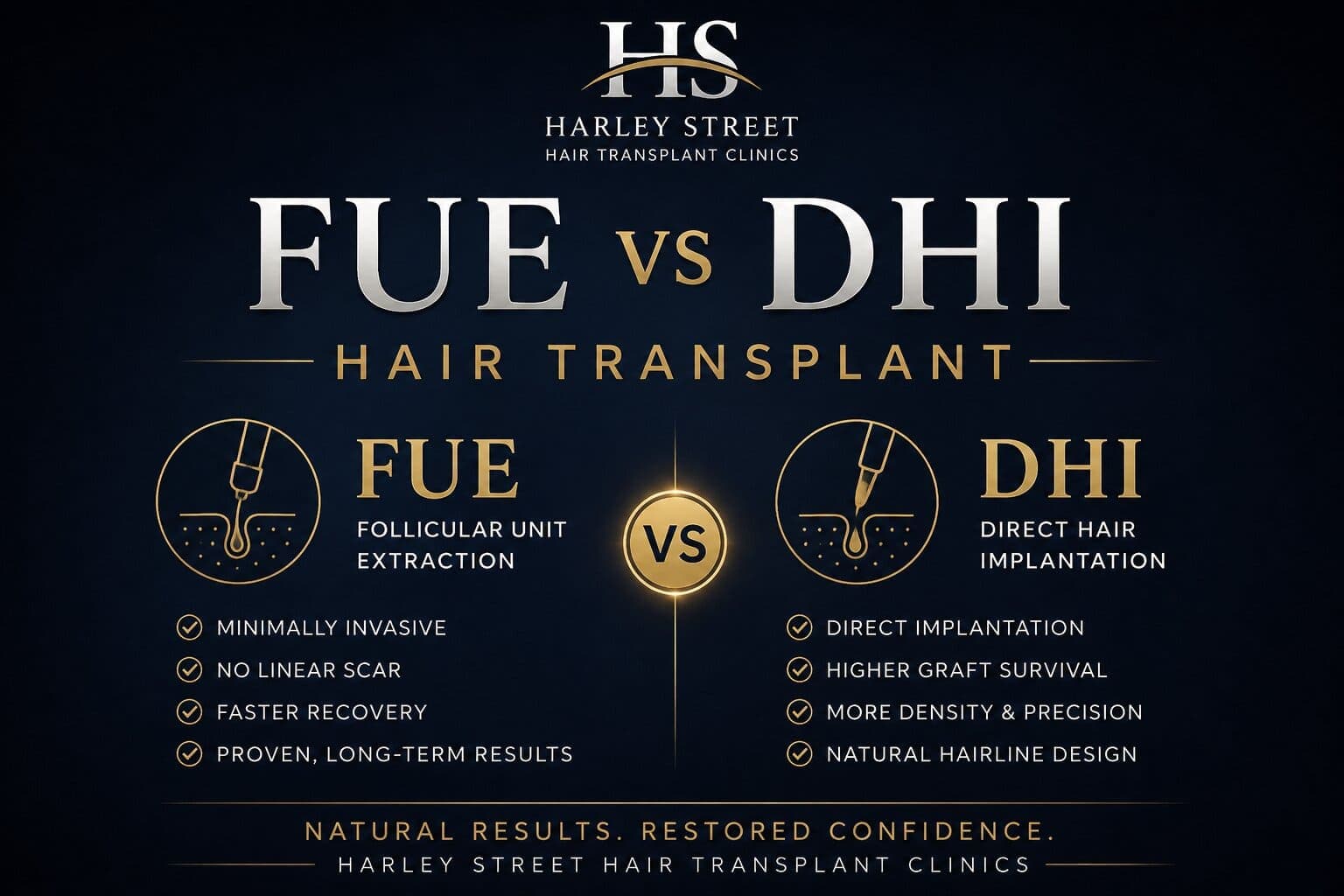
Both FUE and DHI extract individual hair follicles from the back of the scalp and move them to where you are losing hair. The extraction is the same for both. Where they differ is in how those follicles are placed into the scalp, and that difference matters more than most comparisons suggest.
FUE and DHI Hair Transplant in Glasgow
At Hair Transplant Glasgow, both FUE hair transplant in Glasgow and DHI hair transplant in Glasgow are performed by GMC-registered surgeons. The right choice between them depends on your pattern of hair loss, your donor hair characteristics, and the density you are trying to achieve in the recipient area.
How FUE Works
FUE stands for Follicular Unit Extraction. A surgeon uses a fine cylindrical punch, typically 0.75 mm to 0.8 mm in diameter, to score around each follicular unit in the donor zone at the back of the scalp. Each follicle is removed intact and stored in saline solution while the recipient sites are prepared.
The recipient sites are created first. The surgeon uses a blade or fine needle to make small incisions in the thinning area, mapping out the angle, direction, and distribution of the new hair before placement begins. The extracted grafts are then placed into those sites one by one.
This two-stage structure gives the surgeon time to plan the full recipient area before any graft is committed. For most patients and most hair loss patterns, it is the more straightforward of the two approaches.
How DHI Works
DHI stands for Direct Hair Implantation. The extraction process is identical to FUE. The difference comes at the placement stage.
Standard FUE pre-makes recipient sites and then fills them. DHI uses a device called a Choi implanter pen. The surgeon loads a single follicle into the pen’s hollow needle and uses it to create the channel and deposit the follicle simultaneously, in one motion. There is no pre-made site waiting to be filled. Each graft goes in as soon as the channel is opened.
That shortens the time each graft spends outside the body, which is the main clinical argument in DHI’s favour.
FUE vs DHI: The Key Differences
Time outside the body. In FUE, extracted grafts sit in saline while the surgeon prepares the recipient area. In DHI, the gap between extraction and placement is shorter because both steps happen together. Whether this produces meaningfully better graft survival is debated among surgeons, but it is the argument most often made for choosing DHI.
Density. DHI tends to allow slightly higher density placement in a given zone. Because the surgeon controls each graft individually with the implanter pen, follicles can be packed more tightly in a localised area. For patients targeting a concentrated patch rather than a broad restoration, that is worth factoring in.
Shaving. FUE typically requires the donor area to be shaved short before extraction. DHI can often be performed with minimal or no shaving, which matters for patients who cannot or would prefer not to shave their head before the procedure.
Cost. DHI is more expensive. The Choi implanter pens are single-use per session and add a per-unit cost that increases with graft count. The price difference between the two techniques is modest on smaller sessions and more significant on larger ones.
Session planning. FUE’s two-stage structure lets the surgeon map the entire recipient area before placing any grafts. DHI requires decisions to be made in real time with each pen insertion. Both approaches work well in experienced hands, but the planning difference is relevant when a case is technically complex or covers a large surface area.
Which Technique Is Right for You?
FUE tends to be the better fit if:
- You are restoring a larger area such as the hairline, crown, or both
- You are comfortable having the donor area shaved
- Cost is a significant factor in your decision
- Your case involves a high total graft count
DHI tends to be the better fit if:
- You prefer to avoid shaving, or cannot shave for professional or personal reasons
- You are targeting a specific zone and want maximum density concentrated there
- You want to minimise the time grafts spend outside the body during the procedure
Neither technique produces better results across the board. A surgeon with strong experience in both methods will consistently outperform a surgeon who defaults to one. A consultation with Dr Aziz Elgindi or Dr Mohammed Ditta will confirm which approach suits your specific hair loss pattern and donor characteristics.
Cost of FUE vs DHI in Glasgow
FUE is generally the more affordable option. Both techniques are priced primarily by graft count, and the gap between them is smaller on lower-graft sessions. As the session size increases, DHI becomes progressively more expensive due to the consumable cost of the implanter pens.
For a full breakdown of pricing by graft count for both techniques, see the hair transplant cost in Glasgow page. Knowing roughly how many grafts your case requires is worth understanding before comparing prices — our guide to graft counts and session sizes covers the typical ranges.
Make the best investment in yourself and find out more about how we can help eliminate hair loss for good!
Frequently Asked Questions
Neither technique is objectively better. DHI offers advantages in density placement and reduced shaving requirements. FUE is better suited to larger sessions and carries a lower cost. Results depend far more on surgeon skill and patient suitability than on the technique used.
No. Both procedures are performed under local anaesthetic, and the extraction method is identical. Pain levels during and after the procedure are comparable for both techniques.
The scarring profile is similar for both because the extraction process is the same. Both produce small circular dot scars in the donor area that are virtually invisible once hair grows back to a normal length.
In many cases, yes. DHI can be adapted to minimise shaving of the donor area, which is one of the main practical reasons patients choose it over FUE. Whether this is possible in your case depends on your hair characteristics and the size of the session.
DHI sessions typically run longer because site creation and graft placement happen simultaneously rather than in separate stages. For a mid-size session, expect around 6 to 9 hours. FUE sessions of equivalent graft count are usually somewhat shorter.
A consultation is the only reliable way to know. Your hair loss pattern, donor density, target area, and practical preferences all affect which technique will produce the best result in your case. Both techniques are assessed during the same free consultation at Hair Transplant Glasgow.
Patient Testimonials
Aside from achieving fantastic results, we believe that keeping in touch with our patients before, during and after their hair transplantation procedure is paramount – it helps to keep our patients feeling calm and in control. We’re always on hand to provide guidance, support and aftercare advice. Time and again, our patients tell us that this is what sets us apart from other clinics.
You can read our great reviews of FUE hair transplants over on Google and Trustpilot