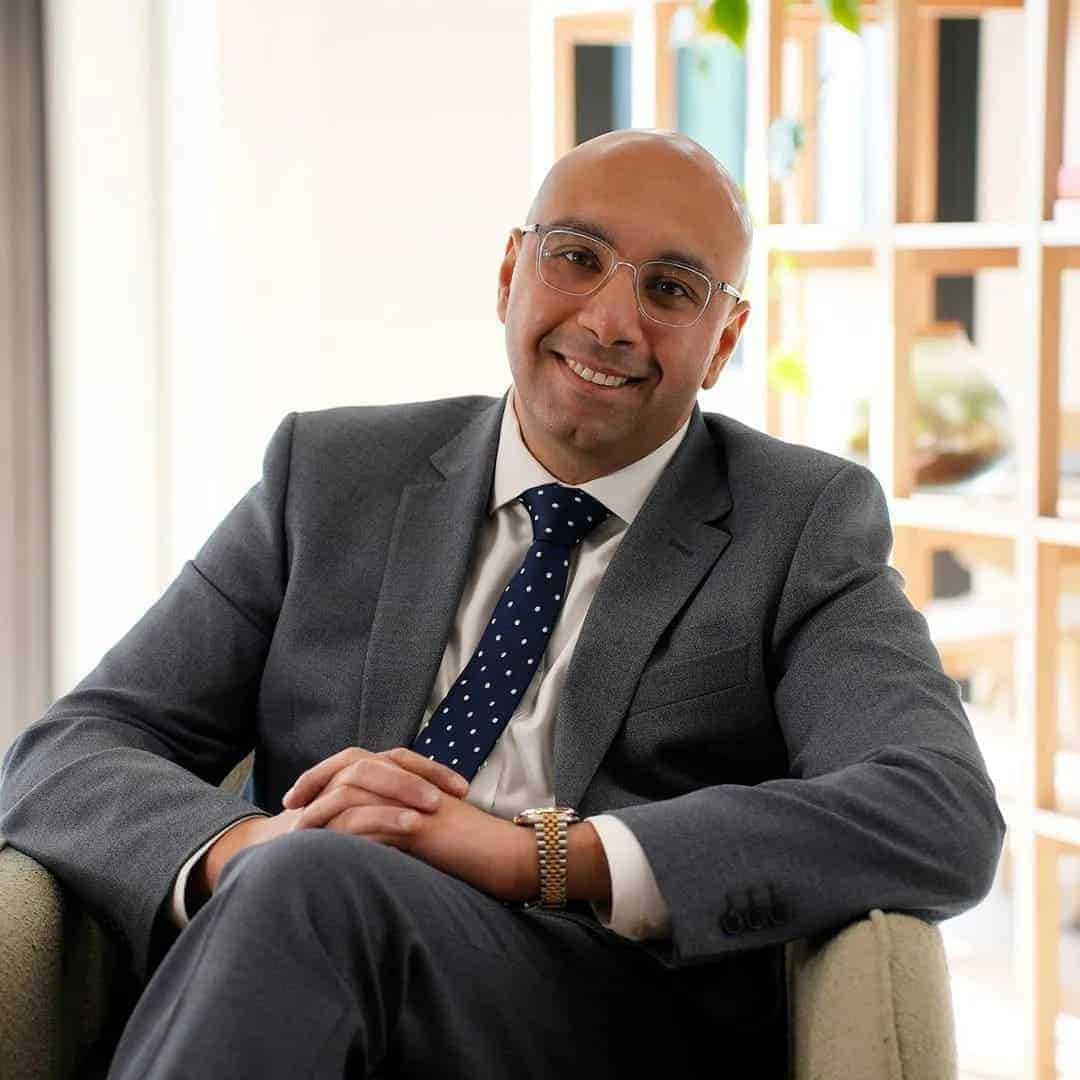



Every procedure at our Glasgow clinic is performed by a doctor on the GMC register
Our clinic is in the heart of Glasgow, a short walk from Buchanan Street subway and Queen Street station
Your surgeon is fully dedicated to your procedure from start to finish
Honest assessment of your donor hair and realistic outcome, no hard sell
Beard Transplant in Glasgow
A beard transplant moves healthy hair follicles from the donor area at the back of the scalp to the face. The transplanted follicles grow exactly as your natural beard hair does. They can be shaved, trimmed and groomed without restriction. The result is permanent.
The procedure suits men with sparse or patchy growth across the cheeks or jawline, complete absence of beard hair, or facial scarring where follicles have been lost. It is also performed for transgender men developing facial hair as part of their transition.
At our Glasgow clinic, all beard transplants are performed by GMC-registered surgeons. No technicians carry out your procedure.
How a Beard Transplant Works
The most commonly used technique is FUE (Follicular Unit Extraction). Individual follicular units are extracted one by one from the donor area using a small circular punch tool with a diameter under 1mm. Each follicle is stored in saline solution until implantation.
The surgeon then places each follicle into the face at the precise angle, depth and direction that matches your natural beard growth pattern. This is what determines whether the result looks natural. Follicles placed at the wrong angle produce an artificial appearance, so our surgeons spend time before the first extraction mapping the beard design around your facial structure and your goals.
The procedure is carried out under local anaesthetic. It takes between three and eight hours depending on the number of grafts. Most patients are comfortable once the anaesthetic takes effect.
For patients who prefer not to shave the donor area, FUT is also available for beard transplant procedures. FUT removes a thin strip of tissue from the donor area rather than individual follicles, so the surrounding hair covers the site without any need to shave. Grafts are separated from the strip and implanted in the same way.
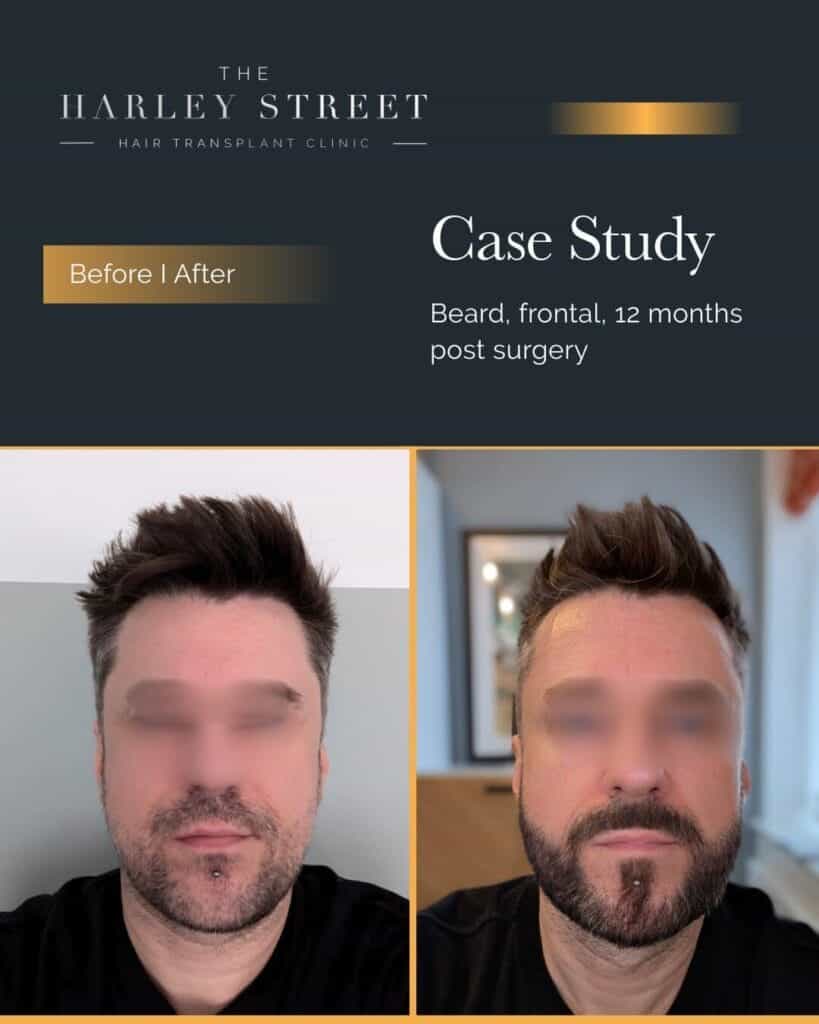
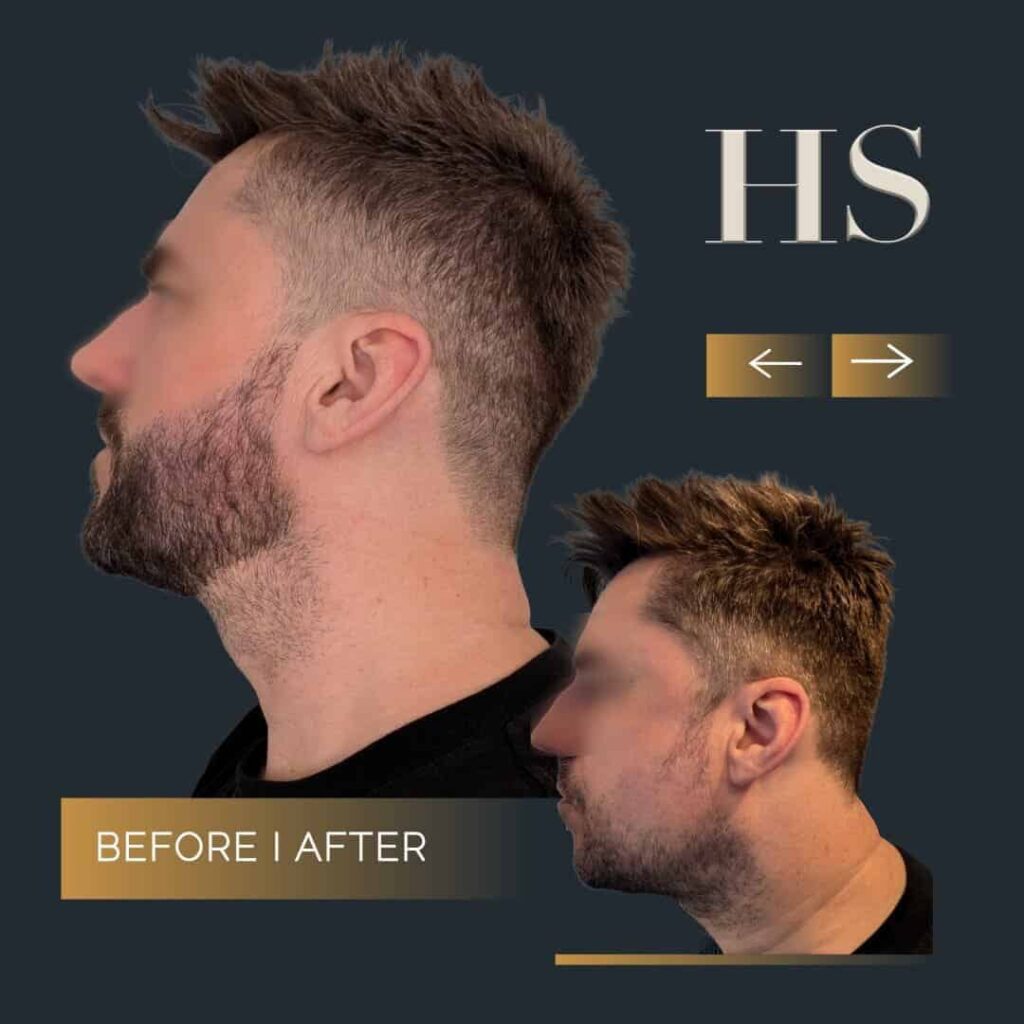
Before and After Beard Transplant Results in Glasgow
A selection of results from patients treated at our Glasgow clinic. All procedures were performed by our GMC-registered surgeons.

Who Is a Good Candidate?
A beard transplant works best when the cause of sparse or absent facial hair is structural rather than active and progressive. Patchy growth across the cheeks or jawline, a complete absence of beard hair, or areas where follicles simply never developed in sufficient numbers are all situations where transplantation can make a significant difference. Men with facial scarring from injury or previous surgery are also candidates: follicles do not grow through scar tissue, but donor follicles transplanted into those sites will.
Alopecia barbae, a form of alopecia areata that causes circular patches of hair loss in the beard zone, can also be addressed where the condition has stabilised. The surgeon assesses activity at consultation before recommending a procedure. For transgender men developing facial hair as part of their transition, the beard and transgender hair transplant page covers the specific considerations in more detail.
The underlying requirement across all of these is a healthy donor area. Hair from the back and sides of the scalp is used because it is resistant to the hormone behind male pattern loss and continues to grow after transplantation. At your free consultation, the surgeon assesses your donor density and gives you a realistic read on what is achievable based on your individual hair characteristics.
Beard Transplant Cost in Glasgow
The cost of a beard transplant at our Glasgow clinic depends on the area being treated and the number of grafts required. Smaller procedures, such as filling in a moustache or sideburns, require fewer grafts than a full beard restoration across the cheeks and jawline.
As a general guide, graft requirements vary as follows:
- Sideburns: typically 400–600 grafts
- Moustache and goatee: typically 1,200–1,800 grafts
- One cheek: typically 2,000–2,500 grafts
- Full beard (both cheeks, moustache and goatee): a larger procedure often completed over two stages, typically requiring around 5,000–6,000 grafts in total
Every patient’s hair characteristics and coverage goals differ, so no two quotes are identical. Your patient advisor will provide a full personalised price following your consultation. For a detailed breakdown of our pricing structure, our pricing page covers every graft band with the fees applied at our Glasgow clinic.
If you prefer to spread the cost, finance options are available and can be discussed with your patient advisor after consultation.
Recovery: What the First Year Looks Like
The first few days involve mild swelling and redness around the transplanted area, with small crusts forming at each graft site as part of the healing process. These are not painful. Do not pick or scratch them. You leave the clinic with aftercare instructions covering how to keep the area clean while it settles.
Around weeks two and three, the transplanted hairs shed. This is the part that unsettles most patients and it is completely normal. The follicles remain alive beneath the skin, entering a resting phase before beginning a new growth cycle. The shedding does not mean the transplant has failed.
New growth begins emerging from around month three. Early hairs are often fine and lighter in colour before they thicken, and the area can look sparse as the follicles settle. By months four to six the difference becomes visible. Most patients can trim and shape for the first time around this point, which gives a reasonable sense of what the final density will look like.
Full maturation takes nine to twelve months. By that point the transplanted follicles behave identically to your natural beard hair. They can be shaved, trimmed, styled and groomed without restriction. The result is permanent.
Make the best investment in yourself and find out more about how we can help eliminate hair loss for good!
Where to Find Us
Our hair transplant clinic in Glasgow is centrally located and easily accessible from across Scotland. Find us in Glasgow City Centre:
69 Buchanan Street
Glasgow
G1 3HL
Our Glasgow clinic is well connected by public transport:
- Subway: Buchanan Street station (less than 1 minute walk)
- Train: Glasgow Queen Street and Glasgow Central stations (both within 5 minutes on foot)
- Bus: Buchanan Bus Station (5 minute walk)
If you are travelling by car, the clinic is a short drive from the M8 motorway and Glasgow City Centre has a range of car parks nearby, including the Buchanan Galleries multi-storey.
Frequently Asked Questions
The cost depends on the number of grafts needed and the area being treated. Smaller procedures such as a moustache or sideburns require fewer grafts than a full beard restoration. Your patient advisor will provide a personalised quote following your free consultation. For a full pricing guide, see our hair transplant cost page.
Graft requirements range from around 400–600 for the sideburns up to 5,000–6,000 for a full beard across the cheeks, moustache and goatee. The exact number depends on the density of your donor hair and the coverage you want to achieve. Your surgeon will assess this at consultation.
Yes. When performed using the FUE technique by an experienced surgeon, transplanted hairs integrate with any existing growth and follow the same natural growth direction. The grafts are placed at the correct angle and orientation to replicate your natural beard pattern. After twelve months the result is indistinguishable from natural beard hair.
In many cases, yes. Alopecia barbae causes patchy, circular areas of hair loss in the beard zone. Where the hair loss has stabilised, transplanting follicles from the donor area into inactive sites can restore coverage. Your surgeon will assess the pattern and activity of the condition before recommending a transplant.
Yes. We perform beard transplants as part of gender-affirming care for transgender men. The procedure is identical: donor follicles from the scalp are transplanted to create natural-looking facial hair. Your surgeon will discuss timing, testosterone therapy considerations and expectations with you at consultation.
The extraction technique is the same: follicles come from the scalp donor area using FUE or FUT. The difference is in placement. Beard hair grows at a much shallower angle than scalp hair, and the direction changes across different zones of the face. The moustache, cheeks, jawline and sideburns each have their own natural growth direction. Surgeons placing beard grafts need to follow that direction closely in each zone to produce a result that looks authentic rather than planted.
Patient Testimonials
Aside from achieving fantastic results, we believe that keeping in touch with our patients before, during and after their hair transplantation procedure is paramount – it helps to keep our patients feeling calm and in control. We’re always on hand to provide guidance, support and aftercare advice. Time and again, our patients tell us that this is what sets us apart from other clinics.
You can read our great reviews of FUE hair transplants over on Google and Trustpilot